

Holloway loading spreaders with compost and gypsum in the Central Valley.
As imported fertilizer costs soar, growers are regaining control with proven soil amendments like gypsum and compost
By Brian Milne
What happens when the inputs our crops depend on are no longer affordable or reliable?
For many growers this season, that’s not a hypothetical … it’s becoming the reality.
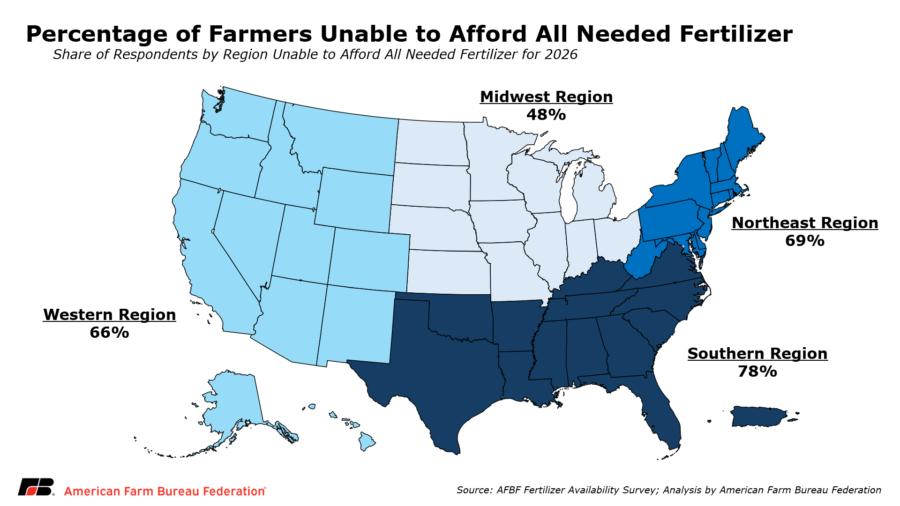
A survey published this week by the American Farm Bureau Federation showed just how much fertilizer prices have surged nationally following disruptions in the Middle East, with many growers now unable to afford the full nutrient programs their crops demand this season.
According to the survey, around 66% of growers in the Western U.S., and 70% of growers nationwide, are unable to afford the fertilizer their crops need for 2026.
 That reality is forcing difficult decisions in the field: cutting rates, delaying applications, or absorbing margin losses. But it’s also accelerating a smarter shift.
Turning to Alternatives
In California, that shift is already underway. In today’s Bakersfield Californian, Holloway Senior Vice President of Products and Sales Daniel Terry underscored a critical point: in a volatile market, knowing exactly what’s in your inputs (and where they come from) is no longer optional. It’s essential.
Locally produced gypsum and compost offer a level of consistency, transparency and supply reliability that imported inputs can’t match.
In the Californian, Terry said the market is “definitely seeing more local growers use compost this year, as well as locally sourced gypsum, than in years past.”

Holloway spreading gypsum in pistachios in the Buttonwillow area.
“I think with what’s going on with the war, people are looking for alternatives,” Terry told the paper.
Why Soil Amendments?
While soil amendments don’t always provide the same rapid and high-concentration nutrient release as synthetic fertilizers applied via irrigation lines, true gypsum, or Dihydrate (CaSO4 +2H2O) such as Holloway’s 55% gypsum, goes to work much faster than other Anhydrite (CaSO4) alternatives due to the additional water molecules making it more water soluble.
Because Holloway’s gypsum immediately goes to work when it comes in contact with water, it provides needed calcium and micronutrients along with increasing nutrient and water holding capacity, reducing the hafmful effects of sodium and other issues that plague California soils and irrigation sources.
Spread in bulk, Holloway’s soil amendments also cover the majority of the root zone, versus just around irrigation emitters, where fertilizers are applied.
“On our fields that need gypsum to help manage sodium, a lack of infiltration, etc., you also get the benefits of calcium in a version that’s much more available for plant uptake,” Holloway Senior Agronomist Allie Cushnyr said. “And with the issues we’re seeing with the cost of other inputs right now, you want something that’s going to go to work fast to address the needs of your field.”
In side-by-side tests against other gypsum alternatives, Holloway’s 55% Gypsum has been proven to better improve calcium levels in tissue samples, along with dropping sodium levels.
Combine gypsum with compost, and growers are able to improve long-term soil health, efficiency and nutrient retention, making the soil amendments a crucial, cost-effective alternative for many operations.

Holloway’s agronomy team offers soil, tissue and water sampling services.
Testing Your Soils, Products Matters
That said, both Terry and Cushnyr added growers should test their soils, tissues and water sources (analyses Holloway’s agronomy team provides) to ensure they are applying what their soil and crop need, along with getting their soil amendment products tested to ensure quality.
“When considering soil amendments, you have to test all parts of your operation (soil, tissue, water) throughout the season,” Cushnyr said. “That’s the best way to ensure you are providing your crops with the right nutrition. Compost, for example, is a great source of nutrients and organic matter, but it also depends on the type of compost and if it’s high quality.”
For example, is the gypsum you are using a fast or slow-release product? Also, compost also requires time for microbes to convert nutrients into a plant form. And what is the nutrient concentration and source of the compost you are using?
Either way, there is no denying soil amendments help improve soil health, structure, microbiology and provide essential nutrients without changing soil pH … all of which improves crop health and quality, reducing the future need for massive amounts of chemical inputs.
Regaining Control
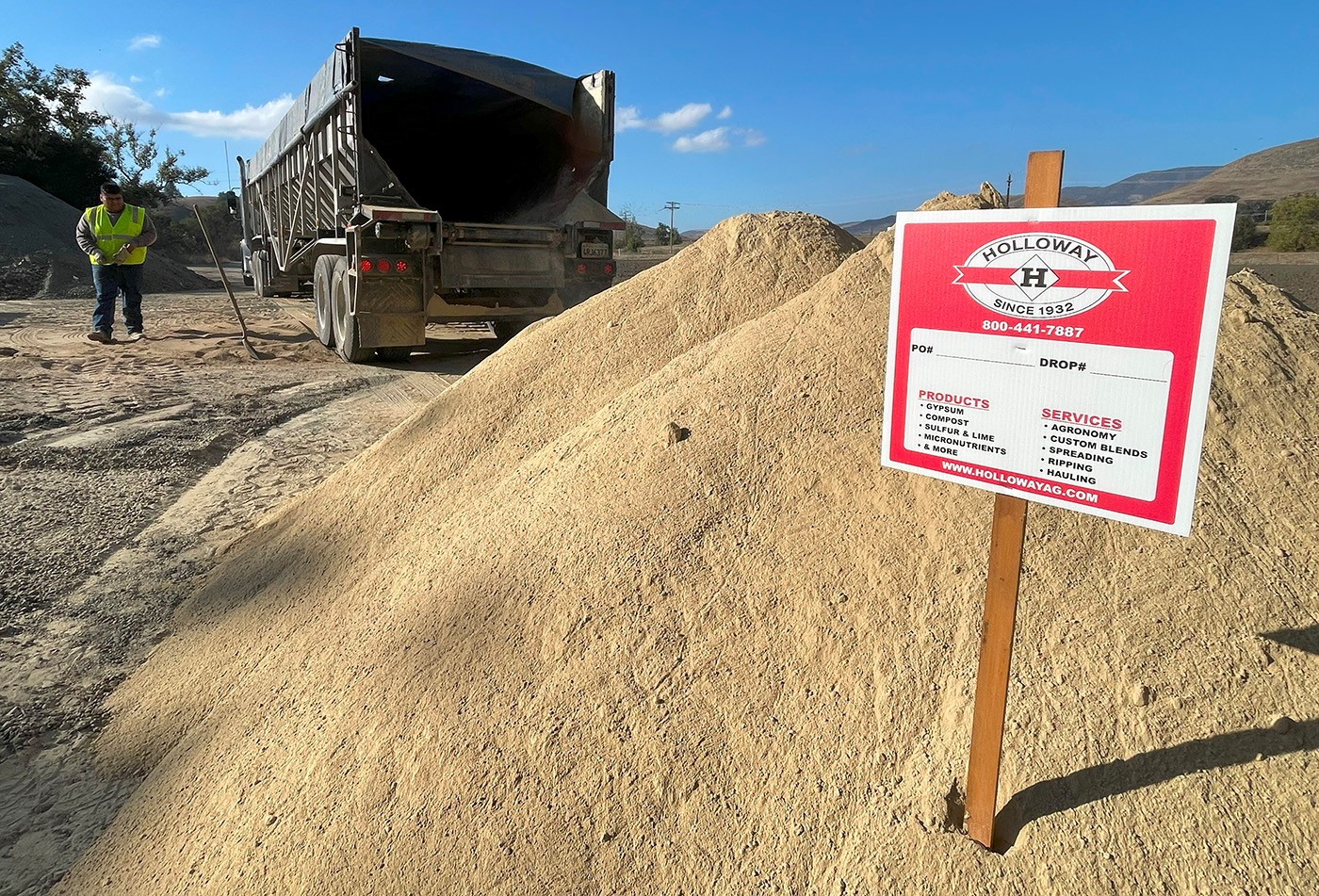
Holloway delivering gypsum to an operation on the Central Coast.
Growers aren’t just looking for cost-effective inputs, they’re looking for control. Control over quality. Control over timing. Control over outcomes. Control over input budgets.
That’s why more operations are turning to locally sourced solutions like gypsum and compost.
Not as a fallback, but as a forward-looking strategy, one that builds soil health, reduces dependency on unpredictable global supply chains and delivers consistent performance season after season.
“The bottom line is you need to know what’s in your soil amendments, to ensure what you’re putting on isn’t counterintuitive to what your soil or crop needs,” Terry concluded. “And with costs where they are, it helps to work with local companies that produce their amendments locally. We’re in the heart of agriculture here. And we know transportation costs are high, so we try to stay local with everything we do.”
At Holloway, we’ve put our soils first since 1932, believing better inputs start at the source. And in today’s environment, that belief isn’t just a philosophy, it’s a competitive advantage for our growers.
Learn more about the Holloway difference today, and contact us to speak with a local agronomist about your inputs and what amendments your operation needs to optimize soil and crop health.
Download the Gypsum Product Analysis
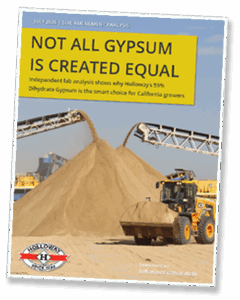 In the summer of 2025, Holloway’s agronomy team had five different forms of gypsum analyzed by an independent third-party lab (Wallace Laboratories) and found that Holloway’s 55%, organic and naturally mined gypsum outperformed others in that it contained only high-quality Dihydrate Gypsum, or Calcium Sulfate (CaSO4+2H2O), versus Anhydrite (CaSO4).
Holloway’s 55% also outperformed others in terms of micronutrients content, and tested out as a cleaner soil amendment without significant levels of lime or dolomite.